mechanical waves
energy transmission
properties of waves
relationship between speed, wavelength and frequency
wave phenomena
standing waves, determine wavelength with the reflection of a standing wave
electromagnetic waves
dipol
propagation of electromagnetic waves
wave phenomena
polarisation of transversal waves
optics - wave optics
interference
conditions for constructive and deconstructive interference with double slit
Young’s double slit experiment:
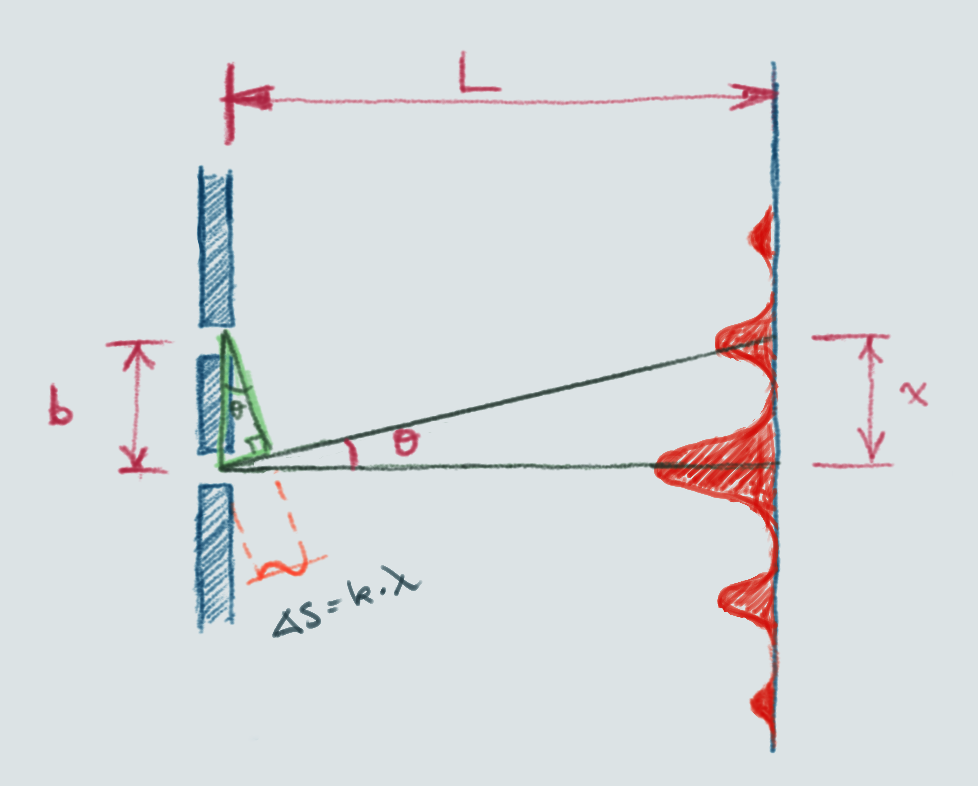
condition for constructive interference (and maxima):
$$\Delta s = k \cdot \lambda$$ $$\sin{\alpha_k} = \frac{k \cdot \lambda}{b}$$
condition for deconstructive interference (and minima):
$$\Delta s = (2k+1) \cdot \frac{\lambda}{2}$$ $$\sin{\alpha_k} = \frac{(2k+1) \cdot \lambda}{2 \cdot b}$$
Example of experiment
Note: For small angles the sine is close the tangent.
The path difference ${\Delta s}$ is a multiple k of the wavelength $\lambda$, where k = 0, 1, 2, … .
Say L = 554 cm , x = 1.4 cm and the gap between the slits is 0.25 mm. Using the relationship
$\frac{\lambda}{b}=\frac{x}{L}$we can calculate the wavelength $$\begin{align}\lambda & = b \cdot \frac{x}{L} \newline & = 250000 nm \cdot \frac{1.4 cm}{554 cm} \newline & \approx 632 ~nm \end{align}$$
This was the actual value of the light emitted by the laser.
decomposition of colours on grating
electromagnetic spectrum, overview of differerent regions
terminology
- wavelength
- wave front
- speed of light
- path difference - Gangunterschied
- node
- antinode
- grating
experiments
- standing wave reflection
- determine the wavelength of monochromatic light using interference
- evidence of polarised and unpolarised light
concepts
superposition and components
- explain interference using the superposition of waves
mathematical model
- describe the position of minima and maxima in the double slit experiment