overview of objectives
mechanical oscillations - mechanische Schwingungen
- Description - Beschreibung der Schwingung eines mechanischen Oszillators
- key properties of an oscillation, frequency and period - Kenngrößen einer Schwingung, Zusammenhang zwischen Frequenz und Periodendauer
- transforming energy - Energieumwandlungen an einem mechanischen Oszillator
- dampened oscillation - Dämpfung einer Schwingung
- period of an oscillation spring - Periodendauer eines Federpendels
$$T = 2 \pi \sqrt{\frac{m}{D}}$$ - equation of harmonic motion - Gleichung für die zeitabhängige Auslenkung bei harmonischen Schwingungen
$$ y(t) = y_{max}\cdot\sin{(\omega \cdot t)}$$ - forced oscillations and resonance - erzwungene Schwingung und Resonanz
electromagnetic oscillations - elektromagnetische Schwingungen
- electromagnetic oscillations - Entstehung elektromagnetischer Schwingungen in einem Schwingkreis
- zeitliche Verläufe von Spannung und Stromstärke in einem Schwingkreis
- THOMSONsche Schwingungsgleichung
$$ f = \frac{1}{2\pi\sqrt{L \cdot C}}$$ - Energieumwandlungen im Schwing- kreis
- Dämpfung im Schwingkreis (qualitativ)
- Vergleich von mechanischen und elektromagnetischen Schwingungen unter dem Aspekt der Energieumwandlungen
oscillator - mechanischer Oszillators
Description
A swing on a playground is a example of an oscillating motion, the string of an instrument when plucked. Motions that repeat themselves periodically.
$${y(t) = A \cdot \sin{\left(\frac{2\pi \cdot t}{T}\right)} }$$
${A}$ is the amplitude.
${T}$ is the period.
${y(t)}$ is the vertical displacement in this case. (books will have different notations)
$f = \frac{1}{T}$ is the frequency measured in Hertz (Hz) where $ 1Hz = \frac{1}{s}$ or $s^{-1}$
Note - There is no phase shift in this applet.
simple harmonic motion (SHM) - harmonische Schwingung
If it is possible to describe oscillations by a sine function, then they are harmonic oscillations.
The graph of the motion is described by the function
time-displacement graph
The blue graph is
$${s(t) = y_{max} \cdot \sin{\left(\omega \cdot t\right)}}$$
where
${\frac{2\pi \cdot t}{T} = 2\pi f = \omega }$${y_{max}}$is the constant amplitude${\omega}$is a factor so that${ \omega t}$is a numerical value. It represents an angle in radians. It is also referred to as the phase of the oscillation.
velocity and acceleration
Looking at the first and second derivatives of the wave function (green and purple respectively) we get
$${\frac{ds}{dt} = \dot{s}(t) = v(t) = y_{max} \cdot \omega \cdot \cos{\left(\omega \cdot t\right)}}$$
$${\frac{d^2s}{dt^2} = \ddot{s}(t) = a(t) = - y_{max} \cdot \omega^2 \cdot \sin{\left(\omega \cdot t\right)}}$$
spring - Feder
The mass oscillates up and down after it has been stretched (or compressed) away from the equilibrium (die Nulllage). The time it takes for one complete up and down cycle is the period T.

linear force - lineares Kraftgesetz
restoring force - Rückstellkraft
spring constant k - Proportionalitätsfaktor D (see Hooke’s law)
m - mass (die Masse)
period $${T = 2\pi\sqrt{\frac{m}{D}}}$$
pendulum
A mass attached to a string oscillates back and forth after being released at a certain angle to the perpendicular to the ground.
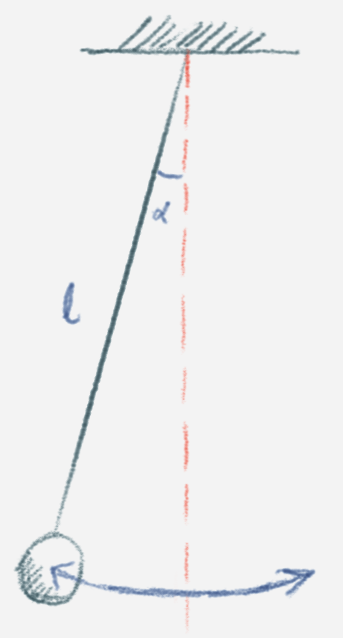
If the angle is kept small, the motion of a pendulum can be considered to obey simple harmonic motion.
Here the period T is calculated by:
$${T = 2\pi\sqrt{\frac{\ell}{g}}}$$
where $\ell$ is the length of the pendulum (in m), g is the acceleration due to gravity (in $\frac{m}{s^2}$)
Addition of oscillations - Überlagerung von Schwingungen
forced oscillations - erzwungene Schwingungen
back coupling - die Rückkopplung
resonance - die Resonanz
Home experiment Heimversuch
links
oscillating circuit - elektromagnetischer Schwingkreis
Thomson- THOMSONsche Schwingungsgleichung
$$T = 2\cdot\pi\cdot\sqrt{L\cdot C}$$
natural frequency - Eigenfrequenz
$$f = \frac{1}{2\cdot\pi\cdot\sqrt{L\cdot C}}$$
Notes
Hooke’s law
force F, elongation s, spring constant D or k
German symbols
$${D = \frac{F}{s}}$$
English (UK) symbols
$${k = \frac{F}{s}}$$
More images
