Cavalieri was an Italian mathematician (1598 – 1647) and a student of Galileo. His theorem is used to compare volumes of all solids.
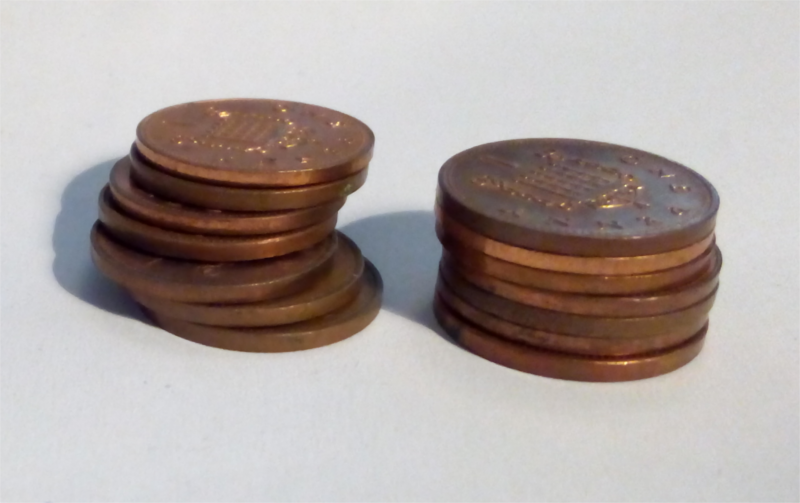
Consider a stack of cards, coins, etc. and change the shape by shifting the cards horizontally.
Has the volume changed?
No, it hasn’t.
pyramids and cones
Cavalieri now uses this to compare pyramids and cones of equal height and equal base area (of different shape).
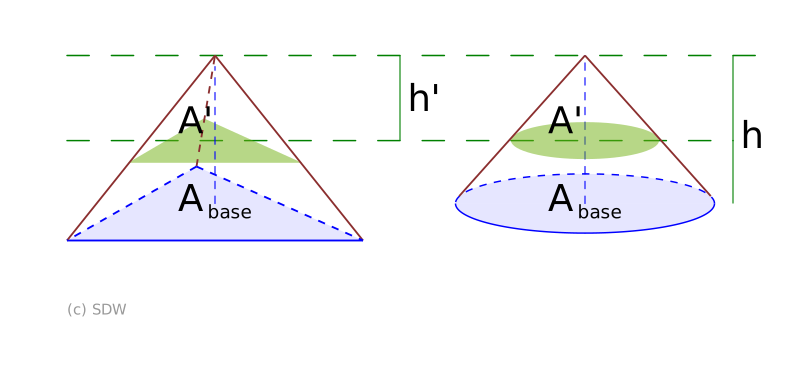
If all areas A’ at the same height h’ in the two solids with equal base area and height are equal, then the solids have the same volume.
Also, see similarity (Strahlensatz)
comparing the volume of a cylinder, a hemisphere and a cone
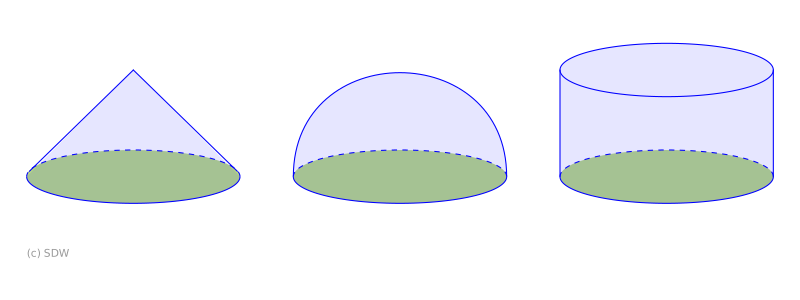
hypothesis
$$V_{\text{cone}} < V_{\text{hemisphere}} < V_{\text{cylinder}}$$
$$\frac{1}{3} \pi r^3 < V_{\text{hemisphere}} < \pi r^3$$
Let us assume that
$$ V_{\text{hemisphere}} = \frac{2}{3} \pi r^3$$
proof#
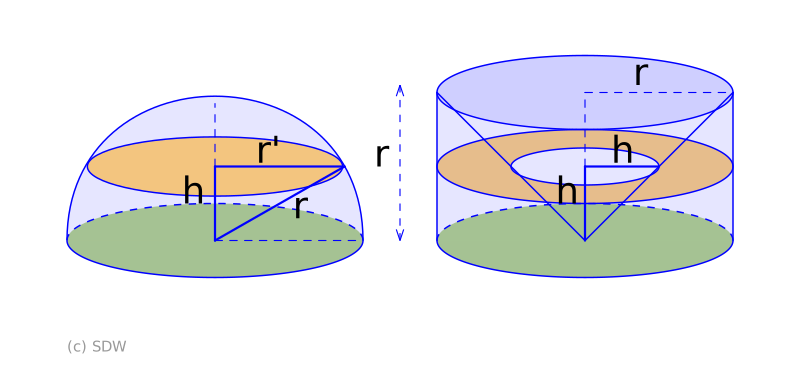
We compare the slice (circle) of the hemisphere with the ring (annulus) left over after cutting out a cone from a cylinder.
Here, h is the height of the plane (parallel to the base) dissecting the solids.
From Pythagoras’ theorem we get the radius of the circle in the hemisphere: $ r' = \sqrt{r^2- h^2}$ and therefore the area of that slice is
$$A_{\text{circle}}= \pi (r’)^2 = \pi (r^2 - h^2)$$
Because of proportionality (“der Strahlensatz”), the area of the annulus (ring) is $$\begin{align}A_{\text{annulus}} & = A_{\text{outer circle}} - A_{\text{inner circle}} \\ & = \pi r^2 - \pi h^2 \\ & = \pi (r^2 - h^2)\end{align}$$
Hence, the area of the circle (of the hemisphere) and the area of the ring (annulus) are equal.
$$A_{\text{circle of hemisphere}} = A_{\text{annulus}}$$
So, according to Cavalieri’s principle, if the areas of the “slices” of two solids cut by the same plane (parallel to the base) are equal, then the volume of the solids is equal.
This means the volume of a cylinder minus the volume of a cone is equal to the volume of a hemisphere (radius and height are matching)
It follows,
$$V_{\text{hemisphere}} = V_{\text{cylinder}} - V_{\text{cone}} $$
$$V_{\text{hemisphere}} = \pi r^3 - \frac{1}{3} \pi r^3 = \frac{2}{3} \pi r^3$$
Hence, for a complete sphere, the volume is twice that of a hemisphere.
$$V_{\text{sphere}} = 2 \cdot V_{\text{hemisphere}} = 2 \cdot \frac{2}{3} \pi r^3 = \frac{4}{3} \pi r^3$$